Full review
The agency diagnosis problem
Every agency owner knows the shape of the problem because they live it weekly. A prospect asks what is broken on their site. A client asks what the retainer bought them. The team spends Monday assembling the evidence, Tuesday building the proposal, and Wednesday explaining the results, and somewhere in between the actual marketing work waits for attention. The grunt work is real: technical audits, keyword checks, competitor screens, budget math, proposal writing, onboarding forms, quote requests. Each piece lives in a different tool or a spreadsheet, and none of them agree on the numbers. The hours are not the complaint. The complaint is that the hours produce evidence in six formats that never quite assemble into a story a client can act on.
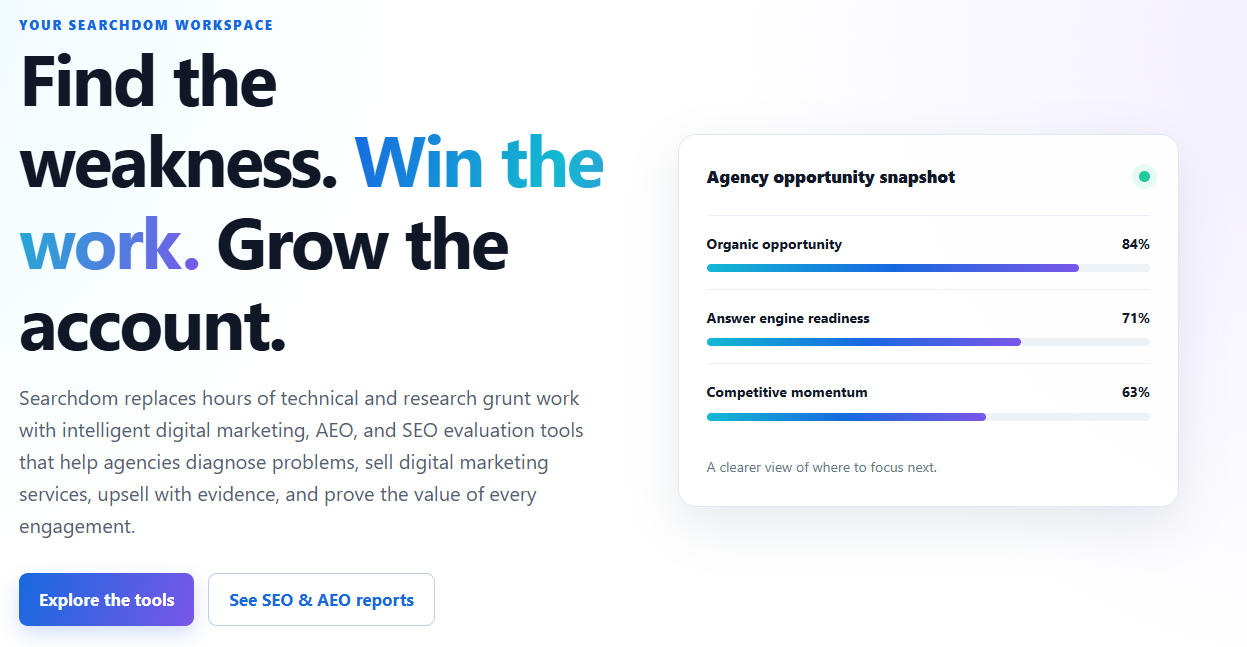
Searchdom exists to assemble the story. It is a connected workspace for digital marketing agencies that replaces hours of technical and research grunt work with intelligent SEO, AEO, and digital marketing evaluation tools. The promise on the label is the whole pitch: find the weakness, win the work, grow the account. Diagnosis with evidence, then a plan, then agreements, then delivery, then reporting, in one connected flow instead of a pile of disconnected tabs.
One platform from prospect to performance report
The reason Searchdom reads as one platform instead of a toolbox is the shape of the journey it covers. Prospecting starts with lead discovery and a prospect evaluator that finds businesses which could actually benefit from agency help. Diagnosis follows: SEO analysis, website analysis, AEO and AIO readiness, and competitor analysis that surfaces the gaps worth selling against. The diagnosis becomes a budget assessment and a proposal with scope, outcomes, and investment spelled out. The proposal becomes a marketing agreement for SEO, Google Ads, or social media ads with deliverables aligned on both sides. The agreement becomes onboarding: a client link for business details, goals, access needs, and project context, plus a service quote request path for the work the client reaches for next. Delivery gets tracked in SEO and AEO reports with keyword rankings, AI snippet visibility, technical health, and content opportunities. Retention closes the loop: case studies built from verified outcomes, and reporting that proves the value of every engagement.
That full arc is the product. Most tools own one station on the line. Searchdom owns the line, which is why it takes the top slot in the agency and SEO categories of this site and carries a five star rating here.
The toolkit in detail
The AEO and AIO readiness tool assesses whether a site is prepared for answer engines, with an evidence-aware rubric that separates real signals from vanity metrics. That distinction matters enormously in 2026, because clients are checking whether ChatGPT and AI Overviews recommend them, and agencies need a way to answer with evidence instead of adjectives. The readiness framework gives the account team a defensible score and a list of concrete fixes, which is exactly the artifact a sales conversation needs.
The case study builder turns verified client outcomes into polished case studies that support sales, credibility, and retention. Agencies win work with proof, and proof usually dies in a shared doc nobody formats. The builder makes the formatting a workflow instead of a project, so the win after a good quarter becomes the asset that wins the next client.
Competitor analysis compares competing businesses to find market gaps and the talking points to outperform them. It is the fastest way to turn a prospect conversation from price to strategy: here is where your market is open, here is the evidence, here is what we would do about it.
Marketing agreements create clear agreements for SEO, Google Ads, and social media ads with deliverables and expectations aligned. Half the agency pain in the world lives in misaligned expectations, and an agreement tool that writes deliverables down before the work starts prevents the disagreement instead of documenting it afterward.
The marketing budget assessment builds a strategy and budget case for SEO, Google Ads, Facebook Ads, or an omnichannel program. Budget conversations usually stall because nobody can show the math. The assessment supplies the math, so the client approves the investment instead of arguing with it.
Marketing proposals build the proposal with scope, outcomes, and investment in one artifact. The proposal is the document that wins or loses the deal, and it should be assembled from the diagnosis, not typed from memory.
New client onboarding gives the client a link to provide business details, goals, access needs, and project context. Onboarding chaos, the missing logins, the forgotten brand assets, the goals nobody wrote down, is a tax on every new account. The link collects the context once, in a structured way, before the work starts.
The service quote request makes it easy for clients to be proactive about additional services, pricing, and account team guidance. Upsell moments usually die in good intentions. A structured request path turns the intention into a ticket before the moment passes.
The prospect evaluator discovers new sales lead prospects for businesses that could benefit from the agency's help. Pipeline is the agency's oxygen, and a tool that finds the next prospects belongs in the same workspace as the tools that close them.
The SEO and AEO reports track keyword rankings on Google search and Google AI snippets alongside technical health and content opportunities. The report is where the agency proves the value of the engagement, and a report that covers both classic search and answer engine visibility matches how clients actually experience the results in 2026.
SEO analysis identifies the technical SEO, content, visibility, entity, intent, and Google search opportunities for a client. Website analysis evaluates readiness, conversion friction, technical barriers, and the work needed to improve performance. Together they are the diagnostic core: the weakness finder that the whole sales motion hangs on.
A note on access: the prospect evaluator and the SEO and AEO reports are marked with an asterisk on the Searchdom site, meaning they require a subscription upgrade. The service quote request and new client onboarding tools are included with the standard subscription. That transparency about tiers is worth noting because agency tooling is full of asterisks that hide behind sales calls. Searchdom prints the structure where you can read it before you commit.
The pain points it removes
Evidence pain is the first. Clients do not renew on promises, they renew on proof, and proof takes hours to assemble from scattered tools. Searchdom assembles the technical signals, content opportunities, competitors, and audience intent into one view, so the recommendation arrives with its evidence attached. The account manager stops being a narrator of screenshots and becomes the person presenting a diagnosis.
Speed pain is the second. Repeatable workflows, proposals, agreements, reports, case studies, become polished client-ready outputs without starting from scratch each time. The template is not a blank page, it is the agency's own standard, applied consistently. That consistency also protects the brand: every client sees the agency in the same professional format instead of whatever the last freelancer invented.
Communication pain is the third. The workspace translates complex search data into clear recommendations that stakeholders can act on. A non-technical owner does not need a crawl log, they need to know what is broken, what it costs them, and what fixing it is worth. Searchdom is built to produce that sentence.
Expectation pain is the fourth. Agreements with aligned deliverables, onboarding links that collect the context before work starts, and quote paths that capture the next ask, all remove the mismatches that turn into disputes. The agency stops absorbing the cost of conversations that should have happened on paper first.
Pipeline pain is the fifth. Lead discovery for businesses that could benefit, competitor gaps that become talking points, and case studies that circulate as proof: the workspace feeds the top of the funnel and the retention loop at the same time. An agency does not need another dashboard, it needs the work underneath one, and the work underneath is prospecting, diagnosis, selling, delivering, and proving.
The AEO gap is the sixth, and it is the one most agencies are losing right now. Clients ask whether they show up in answer engines, and most agencies answer with guesswork because no traditional SEO report covers it. The readiness rubric and the AEO reporting in Searchdom give the agency a defensible answer and a fix list, which turns an uncomfortable question into a service line.
Who Searchdom is for
Searchdom is built for agencies: the owner, the account team, and the strategist who have to diagnose, sell, deliver, and report inside the same week. It fits the agency that runs SEO, Google Ads, and social media ads for clients who need evidence at every step. It fits the small agency that cannot afford a specialist per function, because the workspace carries the repeatable parts. And it fits the growing agency whose proposals and agreements have outgrown the shared doc.
It is not the right pick for a single site owner doing their own marketing, and the site does not pretend otherwise: the language throughout is client journey, account, agreement, and engagement. A solo operator who only needs keyword tracking for one site is buying more workspace than they need. Searchdom earns its place where there are accounts to grow, and the agency categories of this site are exactly that place.
The money math
Subscription tools should be judged on the hours they return, and Searchdom's math is the agency math of hours times accounts. One diagnosis assembled in hours instead of days, one proposal built from evidence instead of memory, one onboarding collected in a link instead of a week of emails: multiply each saving by the client roster and the subscription pays for itself in a single month. The alternative is not free, the alternative is the account team's calendar, and the calendar is the scarcest asset the agency owns. The tier structure is honest about which tools sit behind the upgrade, which means the budget conversation can happen before the commitment instead of after.
The verdict
Searchdom earns five stars because it owns the whole client journey instead of one station on it. Prospecting to diagnosis to budget to proposal to agreement to onboarding to delivery to reporting: each tool hands the next one its evidence, and the account team spends its hours on the client conversation instead of the assembly. The AEO readiness and reporting answer the question clients are actually asking in 2026. The tier asterisks are printed where you can read them. For agencies that sell digital marketing services and have to prove they deliver them, this is the workspace the account team should live in, and it is why Searchdom sits at the top of the agency and SEO categories here.
FAQs
What is Searchdom. Searchdom is a connected workspace of digital marketing tools for agencies: SEO and AEO evaluation, competitor analysis, budget assessments, proposals, agreements, client onboarding, quote requests, case studies, and performance reporting. The tools connect into one flow from prospecting to performance reporting.
What does AEO readiness mean. It assesses whether a website is prepared for answer engines, using an evidence-aware rubric that separates real signals from vanity metrics. The output is a defensible readiness view plus the concrete work needed to improve it.
Which tools need an upgrade. The prospect evaluator and the SEO and AEO reports are marked with an asterisk on the Searchdom site: they require a subscription upgrade. The service quote request and new client onboarding are included with the standard subscription.
Which channels does it cover. SEO, Google Ads, Facebook Ads, and social media ads appear across the budget assessment, proposals, and agreements, with an omnichannel option in the budget assessment.
Which agencies get the most from it. Agencies that sell SEO and paid social services and must prove their work: the diagnosis, the agreement, the delivery, and the report all live in one workspace, so the evidence travels with the account instead of being rebuilt each month.
What a week looks like inside Searchdom
The questions clients ask, answered with evidence