Building a Small-Business Marketing Stack on a Budget
Small businesses are caught in a marketing paradox. On one side, they need more of a marketing stack than ever: an audience lives in email, discovery happens in search and social, and sales increasingly start online. On the other side, the enterprise tools that do those jobs well are priced for enterprise budgets, and stacking five of them produces a monthly bill that can rival the business's other operating costs. The way out of the paradox is not to buy less marketing ? it is to buy it more deliberately, consolidating where consolidation is cheap and spending on specialists only where they earn their keep.
The foundation of any small-business stack is the owned channel: email. Unlike advertising, which stops working the moment the spend stops, an email list compounds ? every subscriber added makes the next campaign more valuable, and the channel costs the same whether it reaches a hundred people or ten thousand. Automation turns that channel into a system: a welcome sequence that runs on signup, a follow-up that fires when a prospect shows interest, a reminder that goes out before an appointment. For a business without a marketing department, automated email is the closest thing to a marketing employee that money can buy.
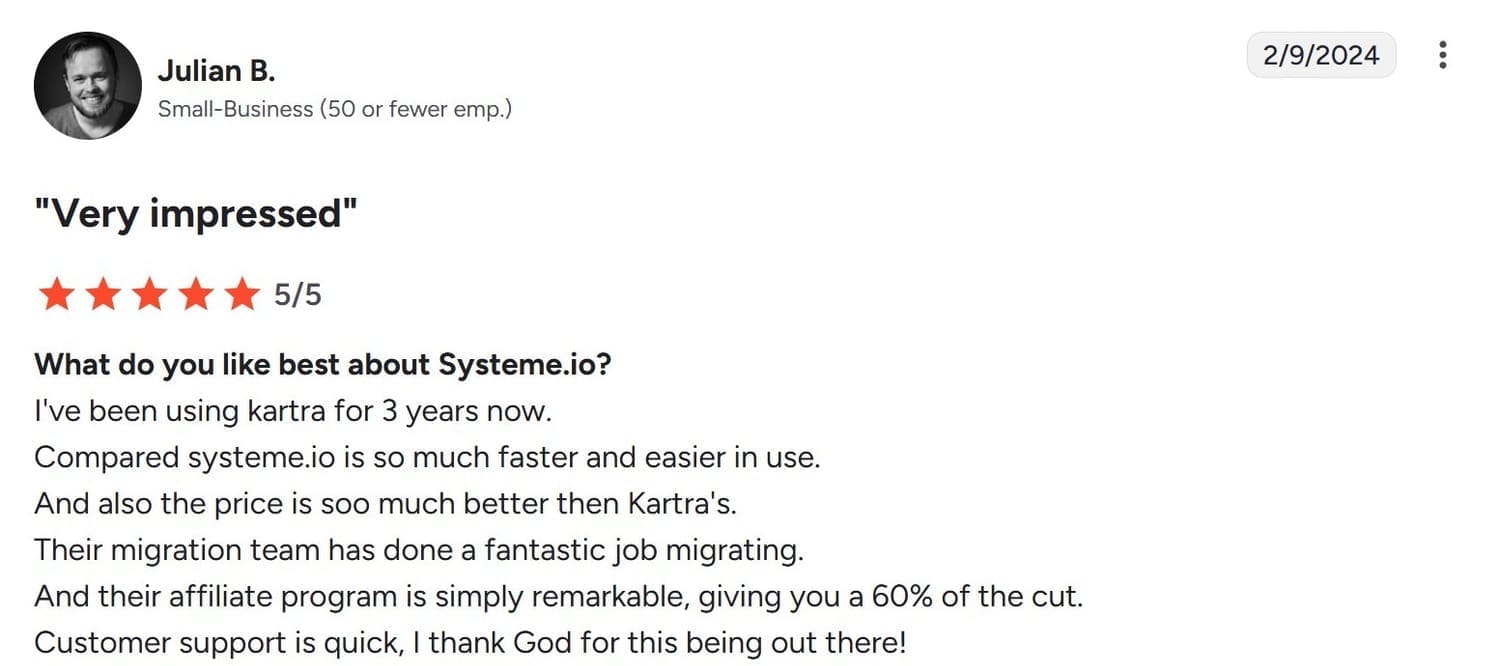
The first strategic decision is how much of the stack one platform should cover. The consolidation option is strongest when a business is starting out and the priority is breadth at low cost. systeme.io is the clearest example: funnels, a website builder, email marketing, automation, and an online-course builder in a single subscription, with a genuinely free starter plan and paid tiers that undercut the category. A business can stand up its entire online presence ? capture, nurture, sell ? on one platform for a fraction of the cost of separate tools. The trade-off is depth: an all-in-one is broad rather than best-in-class at any single thing, which is exactly the right trade for a business whose constraint is budget, not sophistication.
GetResponse makes a similar all-in-one argument with a different center of gravity. Its footprint adds webinar hosting and a course builder to the email and funnel core, which suits a business whose marketing includes live or evergreen webinars ? a consultant selling expertise, a coach running group sessions, a small school selling courses. The platform keeps the audience, the webinar attendees, and the course students in one system, so a follow-up sequence can move a person from one touchpoint to the next without exporting data between tools. For a business that sells knowledge, that integration is worth more than a marginally better email editor.
As a business grows a sales process, the stack's center of gravity shifts from campaigns to customers, and the CRM question arrives. ActiveCampaign answers it by pairing automation-first email with a built-in CRM, so the same contact record that receives a nurture sequence is the record a sales conversation lives on. HubSpot answers it from the other direction: a free CRM as the on-ramp, with paid hubs that add marketing, sales, and service capability as the business scales. The practical difference is where the business starts ? a business that thinks in campaigns starts with ActiveCampaign, one that thinks in pipelines starts with HubSpot ? and both approaches avoid the classic small-business mistake of running marketing and sales on two systems that never talk.
The final discipline is knowing when to add a specialist. Consolidation has a ceiling, and three areas reliably justify breaking through it. Search: when organic search becomes a real acquisition channel, a dedicated SEO toolkit ? Semrush for depth and breadth, Moz for a focused, established tool ? earns its subscription by finding the keywords and fixing the technical issues a general platform will not. Social: when posting becomes a routine rather than an afterthought, a scheduler like Buffer removes the daily friction of publishing. And advertising: when paid acquisition starts, the analytics and conversion tracking that justify the spend usually come from the funnel or CRM platform rather than a standalone ad tool. Each specialist should be added because a specific, measurable need has outgrown the consolidated platform ? not because the tool is popular.
For a small business, the budget stack is therefore a sequence rather than a shopping list. Start with one consolidation platform ? systeme.io for maximum breadth per dollar, GetResponse for the webinar-and-course footprint, ActiveCampaign or HubSpot when the CRM matters most. Run the owned channel relentlessly, because email is the one asset that compounds. Then add specialists one at a time, each tied to a channel that has proven it deserves investment. That sequence keeps the monthly cost proportional to the business's actual needs, and it means every tool in the stack has a job that justifies its place.